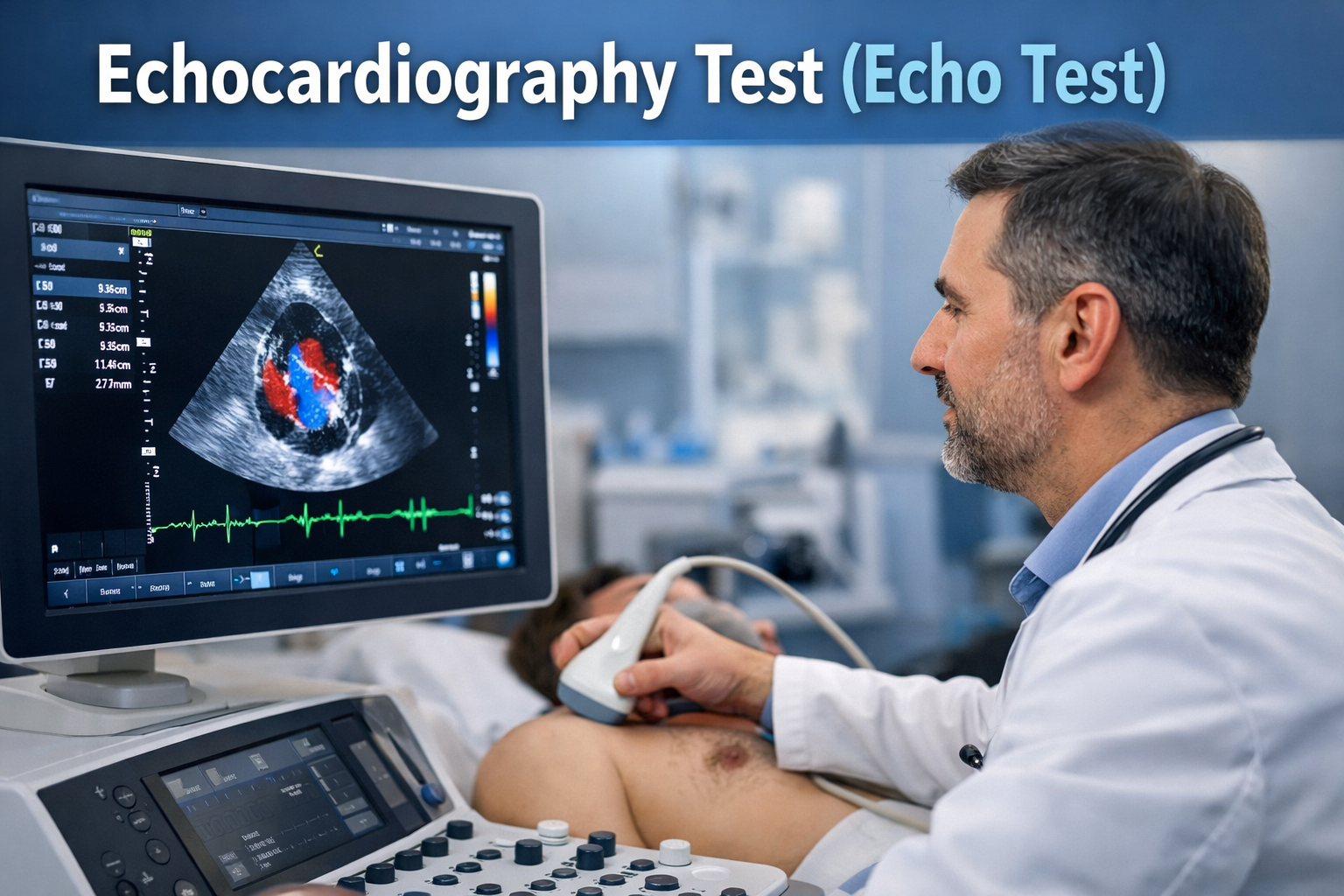
Introduction
The echocardiography test, commonly known as the Echo test, is one of the most important and widely used diagnostic tools in cardiology. It allows doctors to see the heart in motion, assess how well it is working, and detect structural or functional heart problems at an early stage. Unlike many other heart tests, echocardiography is painless, non‑invasive, and does not use radiation.
Heart diseases often develop silently, and symptoms may appear only when the condition becomes serious. Echocardiography helps doctors evaluate heart health before complications arise. Because of its safety and accuracy, it is frequently recommended for patients of all ages, including children, pregnant women, and elderly individuals.
This article is written completely from scratch in a natural, human style. It is designed for direct use on a WordPress website and follows Google‑friendly SEO practices. It explains echocardiography in simple language while covering every important detail.
What Is Echocardiography?
Echocardiography is a medical imaging test that uses high‑frequency sound waves (ultrasound) to create real‑time images of the heart. These sound waves bounce off the heart structures and are converted into visual images on a monitor.
The test provides detailed information about:
- Size and shape of the heart
- Heart chambers and valves
- Heart pumping strength
- Blood flow through the heart
- Presence of clots, fluid, or abnormal structures
Because echocardiography shows both structure and function, it plays a key role in diagnosing and monitoring heart conditions.
Do you want read in urdu article
Why Is an Echocardiography Test Done?
Doctors recommend an echocardiography test for many clinical reasons, either to diagnose a problem or to monitor an existing heart condition.
Common Reasons for Echo Test
- Chest pain or discomfort
- Shortness of breath
- Irregular heartbeat
- Swelling of legs or feet
- Heart murmurs
- High blood pressure affecting the heart
- History of heart attack
- Congenital heart disease
- Monitoring heart valve disease
Example: A patient with long‑standing high blood pressure may undergo echocardiography to check whether the heart muscle has become thickened.
How Does Echocardiography Work?
Echocardiography works on the principle of ultrasound. A device called a transducer sends sound waves into the chest. These waves reflect back from heart structures and are converted into images.
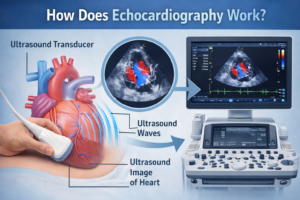
The test shows:
- Movement of heart walls
- Opening and closing of valves
- Direction and speed of blood flow (with Doppler echo)
This real‑time visualization helps doctors assess heart performance accurately.
Types of Echocardiography
There are several types of echocardiography, each used for specific purposes.
1. Transthoracic Echocardiography (TTE)
This is the most common type of echo test.
- Transducer is placed on the chest wall
- Non‑invasive and painless
- Provides excellent overall heart assessment
2. Transesophageal Echocardiography (TEE)
In this type:
- A special probe is passed through the mouth into the esophagus
- Provides clearer images of heart valves and clots
- Used when detailed imaging is required
3. Doppler Echocardiography
Doppler echo measures blood flow through the heart.
- Helps detect valve leaks or narrowing
- Assesses blood pressure inside the heart
4. Stress Echocardiography
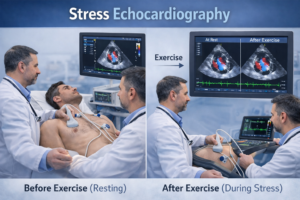
This test evaluates heart function during physical stress or medication‑induced stress.
- Helps diagnose coronary artery disease
- Shows how the heart responds to exertion
5. Fetal Echocardiography
Used during pregnancy to examine the baby’s heart.
- Detects congenital heart defects before birth
Preparation for Echocardiography Test
Preparation depends on the type of echo being performed.
General Preparation
- No fasting required for standard echo
- Wear comfortable clothing
- Remove jewelry around the chest area
For Transesophageal Echo
- Fasting for 6–8 hours
- Inform doctor about throat or swallowing problems
How Is Echocardiography Performed?
Step‑by‑Step Procedure (Transthoracic Echo)
- Patient lies on an examination table
- Gel is applied to the chest
- Transducer is moved over different chest areas
- Images are recorded on a monitor
- Procedure lasts 20–40 minutes
The test is completely painless and safe.
What Can Echocardiography Detect?
Echocardiography helps diagnose and monitor many heart conditions.
Conditions Identified by Echo Test
- Heart valve disease
- Heart failure
- Cardiomyopathy
- Congenital heart defects
- Blood clots in the heart
- Fluid around the heart (pericardial effusion)
- Damage after heart attack
Understanding Echocardiography Results
Echo results are interpreted by cardiologists based on several measurements.
Key Parameters
- Ejection Fraction (EF): Measures pumping efficiency
- Chamber size: Detects enlargement
- Valve function: Checks leakage or narrowing
- Wall motion: Identifies damaged heart muscle
Normal Echocardiography Values (Approximate)
| Parameter | Normal Range |
|---|---|
| Ejection Fraction | 55–70% |
| Left Ventricular Size | Normal adult range |
| Valve Function | No significant leak or stenosis |
Normal values may vary by age and body size.
Echocardiography in Special Populations
In Children
Used to diagnose congenital heart diseases early.
During Pregnancy
Safe for both mother and fetus.
In Elderly Patients
Helps monitor age‑related heart changes.
Benefits of Echocardiography
- Non‑invasive and painless
- No radiation exposure
- Accurate and real‑time imaging
- Widely available and affordable
Risks and Limitations
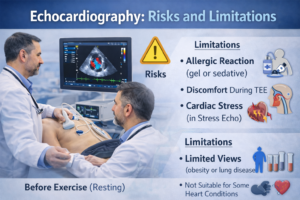
Standard echocardiography has no known risks. Transesophageal echo may cause mild throat discomfort. Echo results may be limited in obese patients or those with lung disease.
Echocardiography vs Other Heart Tests
- ECG: Measures electrical activity, not structure
- CT/MRI: Provide detailed images but are costly
- Echo: Best balance of safety, cost, and information
Frequently Asked Questions (FAQs)
Is echocardiography painful?
No, it is completely painless.
How long does an echo test take?
Usually 20–40 minutes.
Can echo detect blocked arteries?
It can suggest reduced blood flow but angiography confirms blockages.
Is echo safe during pregnancy?
Yes, it is completely safe.
Conclusion
The echocardiography test is a powerful, safe, and reliable tool for evaluating heart health. From diagnosing valve problems to assessing heart failure, echo plays a central role in modern cardiology. Understanding this test helps patients make informed decisions and seek timely medical care.
Disclaimer: This article is intended for general informational purposes only and should not be considered medical advice

Health Samajh ek educational health blog hai jo Urdu aur English dono zabanon mein simple, clear aur trustworthy health information provide karta hai. Is blog ka maqsad logon ko general health, common diseases, healthy diet, fitness, lifestyle aur mental health jaise topics asaan alfaaz mein samjhana hai taa keh woh apni sehat ke hawale se behtar aur informed lifestyle choices kar saken. Health Samajh par maujood tamam content sirf educational aur informational purposes ke liye hota hai aur yeh professional medical advice ya doctor ka badal nahi.